Thursday, 18 January 2018

Savoury Mini Cake Loaf


This is a healthy vegetarian dish which can be served as snacks.
Here I have used Amaranth Flour and Semolina for the base along with vegetables. I have used chickpea leaves as it's available in the market in this season but we can use spinach leaves instead of chickpea leaves
Amaranth Flour contains high source of Protein, Calcium and Fiber. It is ideal for gluten intolerent. It has high levels of the amino acid lysine which help your body to properly absorb calcium from the digestive tract. Here I have used Amaranth flour from Original Indian Table which I had received it as a prize in  a contest. 


Ingredients
1 cup Amaranth Flour
1 cup Fine Semolina
1 small Onion chopped
1 medium size Carrot chopped 
1 medium size Capsicum chopped 
1/2 cup Chickpea Leaves or Spinach chopped 
2 Fresh Green / Red Chillies chopped
1 tsp Garlic chopped
1/2 tsp Ginger chopped
2 1/2 tbsp Walnut chopped
Salt to taste
1 tsp Sugar 
1/2 tsp Turmeric powder 
1 tsp Baking Powder
1 tsp Soda Bicarbonate
1/4 cup Melted Ghee
500 ml Butter Milk

Method
Mix together amaranth flour, semolina, salt, turmeric powder, sugar and baking powder. Mix it. Add the ghee. Now add the butter milk little at a time into the flour and whisk it. Whisk it properly so that no lumps remain and it forms into a thick batter. Add all the vegetables. Mix the batter well. Add the soda bicarbonate and mix it again. Here I have taken 3 mini loaf tin and greased it with ghee. Pour the batter into the pan until 3/4 of the pan is filled. Sprinkle the chopped walnut on top.
Bake it in a preheated oven at 180 degrees for 45 to 50 minutes. After 45 minutes, insert a tooth pick and check. If it comes out clean then it’s done. Remove it from the oven and let it cool a bit. Remove it from the tin, cool it further before slicing. Enjoy it with a cup of tea. 


Monday, 15 January 2018

Chingri Macher Matha diye Kochu Saag Batta..


Prawn head and Colocasia leaves Paste....
 I love traditional dishes. Many of the authentic dishes or traditional home recipes are not available in any restaurants. It’s when some one personally shares them, we get to know. These recipes are not showy but one must taste them to experience it. Recently my love for these kind of traditional simple home cooked recipes have got more rooted in me.. 
This is one such recipe I am going to share with you which is my recipe connecting to my roots. 
 I had some prawn heads left with me after making  the prawn pickle for order. I didn’t feel like throwing them as I personally love to chew the prawn heads and I feel it’s more tastier than the prawn. I also had a bunch of Colocasia leaves in the fridge. So taking these two ingredients, put together... this recipe was created... 


Ingredients 
500 grams Prawn head after cleaning the prawns.. 
(Cleaned, marinated with salt and 1/2 tsp turmeric powder. And fried in Mustard oil.) 
1 bunch of Colocasia leaves chopped without stems
1 medium size Onion chopped 
2 to 3 or more Green chills chopped 
1 tsp Garlic paste
1/2 tsp Ginger paste
1 tsp Tamarind paste
1/2 tsp Nigella seeds / Kalonji 
Salt to taste
1/2 tsp Cumin powder
2 tbsp + 1/2 tsp Mustard Oil
1 roasted dry whole chilli for garnishing.. 

Method 
Take 2 cups of water in a wok and add 1/2 tsp salt and colocasia leaves and let it cook till the water begins to bubble. Switch off the flame and drain the water out from the leaves. Keep it aside. Traditionally the Prawn heads and the Colocasia leaves should have been ground on a shil batta, but I have used a chopper. So first grind the prawn head and then add the leaves and grind them together again. As we don’t want fine paste, it’s better to use a chopper or a food processor. Add 2 tbsp oil in a wok. Let it heat up. Add the kalonji. As the kalonji begins to crackle, add the green chillies, ginger paste and garlic paste. Sauté it for few seconds. Add the onions and let it cook for 2 minutes or till the onions become light pink in colour. Add the prawn head and colocasia leaves paste. On a low flame, stir and cook for 2 minutes.  Add the cumin powder, stir for few seconds. Add the tamarind paste and stir for few seconds more. Now add the salt. Stir and continue to cook for another 2 minutes or till the paste starts to leave the sides of the wok. Remove the paste in a bowl, garnish with roasted whole red chilli and drizzle 1/2 tsp Mustard oil. Later you can crush the red chilli and sprinkle on top. This paste taste even better the next day. Server it with hot steaming rice... 
 P. S. You can add 2 tbsp fresh coconut paste at the end after you add salt and mix it. The coconut flavour will enhance the taste of the fish. 


Wednesday, 3 January 2018

Vegetable Gateau


The vegetable gateau is layered with vegetables, savoury custard and cheese which after baking becomes soft, fluffy and creamy in texture. 
This dish can be served for breakfast or dinner with bread...
It is made with vegetables, cheese, egg and sour cream. 

For the Sautéed Vegetables 
Ingredients 
2 small size Potatoes cut into cubes 
4 tsp of Garlic finely minced 
1 Carrot cut into cubes
1 medium size Egg plant cut into small cubes
1 medium Broccoli cut into small florets  
1 medium bunch of Spinach chopped 
1/2 cup of Green peas 
1 of each colour ( yellow, red and green ) medium size Capsicum cut into cubes 
Salt to taste 
1 tsp Pepper powder
2 cubes / 2 tbsp of Butter


Method
Take a pan, add a cube of butter, let it melt, add 2 tsp of garlic, sauté it for few seconds. Add the 1/2 of the onion chopped, potato, carrot, broccoli, egg plant and green peas. Stir and sauté it for 2 minutes. Add 1/2 cup of water, stir and cover the pan with a lid. Let it cook for 5 minute on low flame. After 5 minuets, open the lid. Season the vegetables with salt and 1/2 tsp pepper powder and stir it. Add the capsicum and stir it again. Remove it in a bowl and keep it aside. 
In the same pan, add the remaining butter and melt it. Add the remaining garlic and onions, sauté it till the onions are light pink in colour. Add the spinach and stir it for a minute. Sprinkle salt and remaining pepper powder. Stir and cook it till the water from the spinach evaporates. Remove and keep it in a bowl. 
P. S. You can also  add cauliflower, mushrooms, French beans too... 

For the Savoury Custard
Ingredients 
1 packet of Sour Cream
4 Egg Whites
4 Egg yolks
Salt to taste 
1/2 tsp Black Pepper powder

Method 
Beat the egg whites till stiff. Separately beat the cream cheese till fluffy. Add salt, pepper and egg yolks. Beat it well. Fold in the egg white and that goes with the vegetables for baking. 

To Assemble 
Ingredients 
Savoury Custard 
Sautéed Vegetables 
1 cup Cheddar cheese grated

Method 
Take a greased baking pan,  pour in 3 to 4 ladles of the custard and spread it. Now add 1/2 of the sautéed mix vegetables and spread it. Pour 2 to 3 ladles of custard over the vegetables and spread it. Sprinkle 1/4 cup of the cheese on the vegetables. Bake it in a preheated oven for 10 minutes at 180 degree celsius. Remove the baking pan from the oven. Add the sautéed spinach and spread it. Pour 2 ladles of the custard over the spinach. Sprinkle 1/4 cup of cheese. Bake for 10 minutes in a preheated oven at 180 degree celsius. Remove the baking pan from the oven. Now add the remaining vegetables and spread it. Pour the remaining custard over the vegetables. Sprinkle the remaining cheese. Now bake it for 15 minutes in a preheated oven at 180 degree celsius. Serve and enjoy this dish with garlic bread...

Sunday, 24 December 2017

Bolo Rei - King’s Cake

Merry Christmas to all...


Bolo Rei (King’s Cake) is a traditional Portuguese cake that is eaten around Christmas, that’s 25th December to 6th January. There won’t be any Christmas without Bolo Rei on the table. Each family in Portugal either buys or makes it at home during the season. 
This recipe made it’s way to Portugal from France during the 19th century when Confeitaria Nacional opened it’s official bakery in 1829. The Confeitaria was the first to introduce this recipe. 
Although it is called a cake,  Bolo Rei is more like a sweet bread.  Traditionally there is a large fava bean and a coin placed inside the Bolo Rei. And the one who gets the bean has to make the cake  for the following year and the one who gets the coin, is the lucky one. 
Normally you can add 50 ml of Port wine into the dry fruits and keep it for overnight but I haven’t add the port wine into my recipe. The dough is kept overnight for rising, but I kept it for 2 hours. 
Here is my version of the recipe - 


Ingredients
500 grams All Purpose Flour 
125 ml Lukewarm Milk
65 grams Caster Sugar 
1 sachet / 11 grams Dry Yeast 
2 Eggs
1 Egg white
100 grams Butter
2 tbsp Candied Apricot chopped 
2 tbsp Candied Cherry chopped 
2 tbsp Raisins chopped 
2 tbsp Black Raisins chopped
1/2 cup Dried Fruits chopped
2 tbsp Walnuts chopped 
2 tbsp Almond chopped 
2 tbsp Cashews chopped 
1 Egg yolk to brush 
2 tbsp Powder Sugar for sprinkle 

For Garnishing 
Ingredients 
1 tbsp Almond chopped 
1 tbsp Walnut chopped 
1 tbsp Dried Fruits
1 tbsp Candied Apricot sliced 
1 tbsp Candied Cherries whole 
Some Lemon Candied peels sliced 

Method 
Take 1/2 the quantity of the lukewarm milk, add 1 tbsp of caster sugar, stir the milk, then add the yeast.  Stir it once again and let it rise. Meanwhile mix all the dried fruits, candied fruits and nuts together and keep it aside. 
Take flour, sugar, butter, eggs, remaining milk and yeast in a mixing bowl and knead it into a dough for 5 to 7 minutes. I have used a kneading machine, but you can also knead it by hand. Cover and keep it aside to rise. Now add the dried fruits and nuts. Knead the dough again. Divide the dough into 2 portions. Take a portion of the dough, roll it into a thick rope and round it into a wreath on a baking sheet.  Cover and keep it for 30 minutes. Then brush the dough with the egg.
Garnish the cake with candied peels, nuts and dried fruits. Bake it in an pre heated oven for 25 minutes at 180 degree celsius. Remove it from the oven and let it cool a bit. Sprinkle with some powdered Sugar.

Wednesday, 13 December 2017

Ram Rochak Tarkari


It’s a delicious Oriya vegetarian dish popular in the Baripada region of Odisha. This dish is made during Ratha Yatra. This a very simple dish. Mung dal dumplings are cooked with vegetables like brinjal and potatoes.  This dish can be served with rice.
This recipe is adapted from Sweta Biswal's blog Oriya Rasoi....


For the Dal Dumplings / Bara
Ingredients
1/2 cup Yellow Split Lentils(Mung Dal) soaked for 1 to 2 hours
1/4 cup Whole Green Gram (Whole Green Mung Dal) soaked for 4 to 5 hours
1/2 tsp Cumin seeds
2 Red Dry Chillies
A pinch of Asafetida
Salt to taste
Oil for fry the dumplings


Method
Add the cumin seeds, dry red chillies, asafetida, salt, yellow mung dal and green whole mung dal in a grinder. Add very little water as the batter should be thick. Grind the dal into a batter. Take oil in a wok and let it heat up. Add a tsp of the batter in the oil. Repeat the process for 3 to 4 times. Fry it till golden brown in colour. Remove it from the oil and keep it aside.

For the Masala Paste
Ingredients
2 to 3 small pieces of Ginger
2 Dry Red Chillies
1 small Green Chilli
1/2 tsp Cumin seeds
3/4 tsp Coriander seeds
1/2 tsp Turmeric powder


Method
Add the ginger, red chillies, green chilli, cumin seeds, coriander seeds and turmeric powder in the grinder and grind the ingredients. Add 2 to 3 tbsp water and grind it again into a paste.

For the Curry
Ingredients
Mung Dal Dumplings
1 cup Brinjal cut into medium cubes
2 medium size Potatoes cut into medium size cubes
1 Green Chilli slit
1 Green Cardamom
1 small piece Cinnamon
2 Cloves
Salt to taste
Masala paste
2 tbsp Oil
1/2 tsp Ghee


Method
Reduce the oil in which the dumplings had been fried to 2 tbsp. Add the cumin seeds, clove, cardamom, cinnamon and green chilli. Let it crackle. Add the masala paste. Sauté it till the oil leaves the masala. Add the potatoes. Stir and cook for a minute. Add the brinjal. Stir and cook for another minute. Add 1 1/2 cups of water. Stir, cover and cook for 10 minutes. Open the lid, add salt to taste. Stir, cover and continue to cook until the potatoes are 80 percent done. Open the lid, check if the potatoes are almost done. Add the dumplings and continue to cook for another 4 to 5 minutes. Drizzle ghee and switch of the flame. Serve it with hot steaming rice. 


Wednesday, 6 December 2017

Dumur er Dalna


Dumur means ‘Fig’ in English. It is commonly found all over the world. Ripe and dried fig (Anjeer)is eaten and known to all of us, but the raw / tender fig which is cooked into delicious curry or sabji is not known to many. 

This is not only delicious but is healthy too.
As kid when ever I travelled to Kolkata, I have eaten this many a times in my Aunty’s house, but staying in Mumbai, though there are many fig trees, the raw tender fig or kochi Dumur is not available at all. Since I have not been to Kolkata for many years, I couldn’t source it out. A big thanks to my neighbor who got this for me from Kolkata. I was craving for it.
These ones are very small in size so, I had to cut into 2 halves and scoop the seeds out. The little bigger ones can be cut from the sides and the center seeds can be directly discarded. As the cutting and cleaning process is a bit tedious, this recipe is now not made very often in the urban kitchen. 
There are many recipes made with dumur. I still remember as a kid Dumurer Jhol was given when I was sick. This is an vegetarian recipe without onion and garlic. You can serve this dish with roti or rice. 

Ingredients
250 grams Dumur or Fig
2 medium size Potato cut into small cubes
1 Tomato puréed
1 tbsp Ginger and Cumin paste ( 1 small Ginger piece and 1 tsp Cumin seeds)
2 Green Chillies slit
1/2 tsp Cumin seeds
2 Bay Leaves
Salt to taste
1 tsp Sugar
1/2 tsp Turmeric powder
1/4 tsp Garam Masala powder
2 tbsp Oil
1/2 tsp Ghee


Method
Cut the fig into 2 halves and with the edge of the knife scoop out the seeds. Put the cut pieces into the water. Now take some water in the vessel. Add 1/2 tsp turmeric powder and salt. Add the fig pieces into the water and boil it till tender. Don’t over cook. Drain the water and keep it aside.

Heat up the oil in the same vessel. Add the cumin seeds and bay leaves. Let it crackle. Add the ginger and cumin paste. Sauté it on low flame for a minute. Add the tomato purée. Stir and cook for a minute. Add the sugar, turmeric powder and salt. Stir and let it simmer for a minute till the oil separates from the paste. Add the potatoes, stir and cook for a minute. Now cover and cook for another 2 minutes on low flame. Open the lid and stir, add the green chillies and stir again. Now add the boiled dumur. Stir and cook for a minute. Now cover and cook for another 2 minutes on low flame. Opened the lid, stir and add a cup of water and stir again. Cover and let it simmer on medium low flame till the the water has reduced and the potatoes are cooked. Open the lid and check if the potatoes are cooked. Sprinkle garam masala powder and drizzle some ghee on top. Switch off the flame. Serve Dumur er Dalna with roti or rice.

Wednesday, 29 November 2017

Instant Fresh Turmeric and Ginger Pickle....


Turmeric is a root that can be found in the market through out the year, but the fresh ones are seen in winter. It is easy to grow in a container or a pot. It has many medicinal properties like anti-inflammatory, anti-fungal, and it’s antibacterial. It’s used for internal health related issues as well as applying on cuts and bruises.
In India we grind the dried turmeric roots into powder and use it in our daily cooking. We also add turmeric into a glass of milk and drink it. My father when he was alive, always wanted a piece of fresh turmeric with his meal... 
Recently my friend Rachana had had got fresh turmeric and ginger pickle with the paratha and I just fell in love with it... I got inspired to make this delicious pickle. 
Here is my version of the pickle...

To make the Spice powder
Ingredients
15 Guntur Chillies
1/2 tsp Fennel seeds
1 tbsp Coriander seeds
Method
Add the red chillies, coriander seeds and fennel seeds in a grinder. Grind the ingredients into a fine powder. 

To make the Pickle
Ingredients
250 grams Fresh Turmeric peeled and grated
200 grams Mango Ginger peeled and grated
100 grams Ginger peeled and grated
Spice Powder
Salt to taste
Juice of 3 Limes 
2 tbsp Split Mustard seeds
1 tsp Split Fenugreek seeds
1/2 tsp Mustard seeds
1/4 tsp Asafetida
100 ml Sesame Oil
Method
Roast the split fenugreek seeds and split mustard seeds on a low flame for few seconds. Remove them from the flame and let it cool. Mix the split mustard and fenugreek with the spice powder.
Take the oil and heat it up. Once the oil is hot, lower the temperature of the flame. Add the mustard seeds and let it crackle. Add the asafetida and ginger. Stir and cook for a minute. Now add the grated mango ginger and fresh turmeric. Stir and cook for 3 to 4 minutes. Add the spice powder and salt. Stir it together for a minute. Add the lime juice. Stir it well for few seconds. Switch off the flame. Cool the pickle and store it in a dry container. This pickle can stay for 6 months in the fridge. Enjoy the pickle with paratha or curd rice. 

Tuesday, 21 November 2017

Phulkopir Singara


Singara in Bengal is different from Samosa which is made in other parts of India because of the stuffing and the spice powder that is used. Phulkopir singara is best to make during winters as cauliflower is easily available in the market.  
To make the singara crispy, the  moyen / amount of ghee or oil has to be proper and mixed well with the flour.  Instead of cashews you can also fried peanuts and add it to the stuffing. 
While frying the singara the temperature of the oil has to be low to get uniform golden colour and crispness. Serve the singara with tetuler / tamarind chutney. 


For the Stuffing 
Ingredients
1 large size Potato cut into medium size cubes 
1 cup Cauliflower cut into small  florets 
1/2 cup Green Peas 
2 Green Chillies chopped 
1 tsp Ginger minced 
1 tbsp Raisins 
1/2 tsp Cumin seeds 
2 Bay Leaves 
1 tbsp broken Cashew nuts
1/2 tsp Turmeric powder 
1 tsp Sugar 
Salt to taste
2 1/2 tsp Bhaja masala (Dry roast 1 tsp Cumin, 1 1/2 tsp Coriander seeds and 1 Dry red chilli. Cool it and grind it into fine powder)
1tbsp Ghee
Method 
Take 2 cups of water in a pot. Add potatoe, cauliflower, peas and salt. Boil it till the vegetables are cooked. Drain the vegetables and keep it aside. Heat Ghee in a pan. Add cumin seeds and bay leaves. Let the Cumin seed crackle. Add the cashews, stir an sauté till the cashews are brown in colour. Add the green chillies and ginger. Stir for a minute. Add the vegetables, raisins, salt, sugar and turmeric
powder. Stir and cook for a minute. Add the bhaja masala. Stir and mash some of the vegetables. Switch of the flame and transfer it into a bowl. 

For the Dough and Singara
Ingredients 
1 1/2 cup All Purpose Flour 
Salt to taste 
1/4 tsp Soda bicarbonate
1 1/2 tbsp Ghee
Stuffing 
Oil to fry 

Method 
Add salt and soda bicarbonate into the flour. Mix it. Add 1 tbsp ghee. Mix the flour well using your finger tips. Add little water at a time and knead the flour into a hard dough. Add 1/2 tsp ghee and knead it well. Keep the dough in a bowl, cover and let it rest for 15 minutes. Take a lime size ball. Roll the dough into a ball. Flatten the ball on the rolling board. Apply little ghee on the dough and roll the dough into a round disc. Cut the disc into halves. Take one part of the cut disc. Fold the straight edges to make a cone. Fill 3/4th of the cone with the stuffing. Seal the opposite ends of the opening by pressing with your finger. Repeat the same process till you make all the singara. Take oil in a wok. Heat the oil on a low heat. Add the singara and fry on a low heat till it is uniformly golden brown from all sides. Remove it on a paper towel. Serve it hot with tetuler / tamarind chutney. 


Monday, 6 November 2017

Manji Pulimuchi


Pulimuchi is a sour and spicy Mangaloren Style masala gravy dish cooked with fish or chicken.
The gravy can be dry or semi dry as per one’s choice. This is a finger licking dish that can be served with Rice or Neer dosa.
Here I have used Pomfrets.

For the Masala Paste
Ingredients
20 or more Red Guntur Chillies as per the spiciness required - Soaked in water for 30 minutes
2 Onions chopped
16 Garlic Cloves peeled
1 small Ginger chopped
1 Green Chilli
1 1/2 tsp Tamarind Paste
10 Pepper Corn
1 tsp Cumin seeds
1 tsp Coriander seeds
Salt to taste

Method
Grind the cumin, coriander and pepper till it is in powder form. Grind the onion, ginger, garlic, green chilli and 1/2 of the red chilli along the powder into a fine paste. Add the remaining red chillies, tamarind, salt and little water and grind the all ingredients together into a thick fine paste.

For the Pomfret Masala Gravy
Ingredients
4 medium size Pomfret marinated with Turmeric and Salt for 15 minutes
Few Curry Leaves
Masala Paste
1/2 cup Coconut Oil

Method
Take a flat pan. Add the oil and heat it. Add the masala paste, stir fry it for 2 minutes. Add the curry leaves. Continue to stir fry for another minute. Spread the masala on the pan. Place the pomfrets in the masala. Apply some of the masala on the top part of the pomfret too. Cover and let it cook for 5 minutes on a low flame. Remove the lid. Turn the pomfrets. Cover and cook the pomfrets father till the oil from the masala releases and the pomfrets are done. Serve the Pomfrets with Neer Dosa.

For the Neer Dosa Recipe click on the link given below....


Neer Dosa


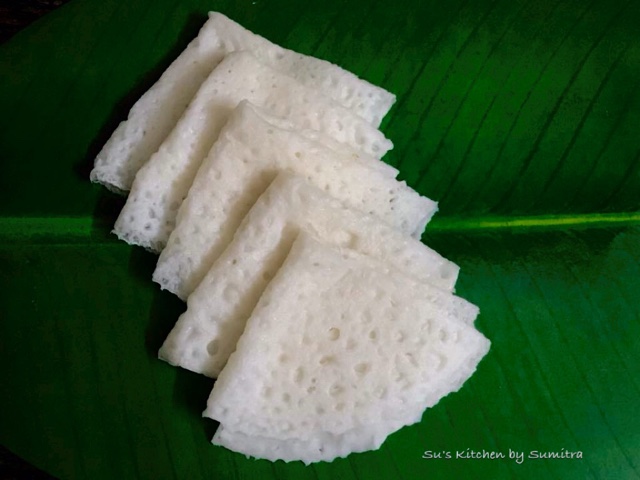
Neer dosa literally meaning water dosa in Tulu. This dosa is prepared from rice. Neer dosa is a delicacy from Tulu Nadu region and a part of Mangalorean cuisine. This can be had for breakfast, lunch or dinner. It is served with Chutney or any gravy dish. 

Ingredients
1 1/2 cup Raw Idli Rice 
1/2 cup Fresh or Desiccated Coconut
Salt to taste

Method
Soak the rice at least for 2 hours. Grind the rice along with coconut and 1 cup water into a smooth batter. Do not add excess water while grinding. 
Transfer the batter from the grinder into a bowl. Now add 2 cups of water and salt into the batter. The batter should be watery. Add more water if required. Take a skillet or pan. Spread some water over the pan, the water should sizzle and then pour a ladle full of batter over the hot pan. Rotate the pan and spread the batter. Cover the dosa with a lid and allow to cook on medium flame. Fold the dosa into a triangular shape. Serve the Neer dosa with chutney or any curry or fried dish. 


Friday, 3 November 2017

Phulkopir Roast


As winter approaches there are varieties of winter vegetables that comes in the market. Phulkopi / Cauliflower is one of  the winter vegetable that is one of my favorite. This vegetable is used to make various dishes. Phulkopir Roast is one of the vegetarian dish made with Cauliflower, as the name says it all.  This is an old Bengali dish made during occasions. Many of the restaurants in Kolkata serves this dish during Durga Puja. This is a very simple dish made without any garlic and onions. It can be served with rice or paratha or rotis. 

For the Masala Paste
Ingredients
1 tbsp Raisin soaked in 3 tbsp water
1 inch Ginger chopped
2 Green Chillies
1 tsp Coriander seeds
3/4 tsp Cumin seeds
3/4 tsp Kashmiri Chilli Powder
Method 
Add all the above ingredients in a grinder and add little more water. Grind all the ingredients into a fine paste. 

For the Cauliflower Roast
Ingredients
500 grams Cauliflower cut into medium size florets
Masala paste
Salt to taste
1 tsp Sugar 
2 Bay Leaves 
1/2 tsp Bengali Garam Masala (2 Cardomoms, 3 Cloves and 1 small stick Cinnamon ground into powder)
1/4 cup Curd
1/4 cup Mustard Oil
1 tbsp Ghee 

Method 
Take 1 liter water in a wok. When the water becomes hot, add 1 tsp salt and let it bubble. Switch of the flame. Add the Cauliflower and let it stand for 15 minutes. Drain the water out. Add mustard oil in the wok. Let it heat. Add the cauliflower and fry it till it’s colour changes. Remove the cauliflower from the oil. In the same oil add the bay leaves. Add the masala  paste and on a medium low flame, sauté the paste till the oil begins to separate from the paste. Add the curd and continue to cook. Add the sugar. Cook for 2 minutes. Add the cauliflower. Stir and cook for another 2 minutes. Add 1/4 cup water, cover and cook the cauliflower till done. Keep stirring it occasionally. Add little water and salt in between as the cauliflower takes time to cook. Once done add garam masala and ghee. Serve hot with rice or roti.