Thursday, 11 June 2020

Chicken - Aloo Tikki


This is a bit different Chicken - Aloo Tikki recipe, that I made in my Kitchen. Chicken boneless pieces are required, along with potatoes and with just few spices like cloves, cinnamon and cardamom that goes into a Bengali garam masala. 
This dish goes well as a starter and as snacks. This can be served with green coriander chutney and ketchup. 


Ingredients 
10 to 12 medium pieces of Boneless Chicken  preferred 
2 medium size Potatoes (peel and chop 1 potato into very small pieces and peel and cut the other potato into big pieces as it will grind with the chicken) 
2 Green Chillies (1 Chilli to grind and another chilli to slice) or added chillies as per requirement. 
5 to 6 Garlic Cloves 
1 small Ginger piece
1 tbsp chopped Coriander 
2 tbsp Sour Curd 
Salt to taste 
1/4 tsp Garam Masala powder 
1/2 cup Rice Flour
1/4 cup Fine Semolina 
1/4 cup Vermicelli 
Oil to fry 
Method 

Take a grinder jar, add the chicken pieces, big potato pieces, 1 chilli, garlic, ginger and salt. Grind the ingredients into a paste, add 2 tbsp curd and grind the paste once more. Remove the paste into a bowl. Add the chopped potato pieces, sliced chilli and chopped coriander leaves. Mix the ingredients together. Add the rice flour, mix it and keep it aside for an hour. Add the vermicelli and mix the ingredients together, now add the semolina and garam masala powder. Mix the ingredients once more. Heat up the oil in a wok, Take small lime size portions and flatten the ball. Once the oil heats up, add the tikkis into the oil, fry the tikkis on medium low flame until golden brown in colour. Remove the tikkis on a paper towel. Serve the tikkis with green chutney and ketchup. 

Tuesday, 9 June 2020

Discarded Sourdough Starter Whole Wheat Bread


We can create great dishes out of the discarded sourdough starter. So keep them and use them, instead of throwing them. 
Tried this Discarded Starter whole wheat bread.. it’s tasty.... do try them..

Those who want to start the sourdough starter, here is a link below-
Sourdough Yeast Starter


Ingredients 
2 1/2 cup Whole Wheat Flour
2 cups of Sourdough Discarded Starter 
1 tsp Pink Salt
2 tsp Honey 
1/2 cup Lukewarm Water
1 tbsp Oil


Method 
Take a mixing bowl, add the whole wheat flour and the discarded starter. Knead the ingredients together for 2 minutes. Add the honey, salt and lukewarm water. Continue to knead until all the ingredients comes together and forms a dough. Apply oil and cover the bowl and leave the dough to rise. It will take 2 to 4 hours.  Sprinkle some dry whole wheat flour and knead the dough by stretching and pushing for a minute. Roll and shape up the dough.  Sprinkle some flour into the basket the dough will be proofing. Put the dough and cover the basket with a cloth. Cover and let it rest for 30 minutes to an hour. Meanwhile start the oven at 250 celsius and preheat for 15 minutes. Take a baking tray, put a parchment paper on the baking tray. Gently turn the dough on the paper from the basket. Take a new blade and score the bread as per the desire. Take a small bowl of water and keep it on the lower rack of the oven. Keep the baking tray in the middle rack, bake at 225 degrees celsius for 5 minutes. Then reduce the temperature to 200 degrees celsius and bake for 15 minutes, reduce the temperature to further 175 degrees celsius and bake for 20 minutes. Switch off the oven, the bread stay for 5 minutes in the oven, keep the oven door slightly open. After 5 minutes open the oven and remove the baking tray. Keep the bread on a cooling rack until it cools down. After it cools down than you can slice it. 

Monday, 8 June 2020

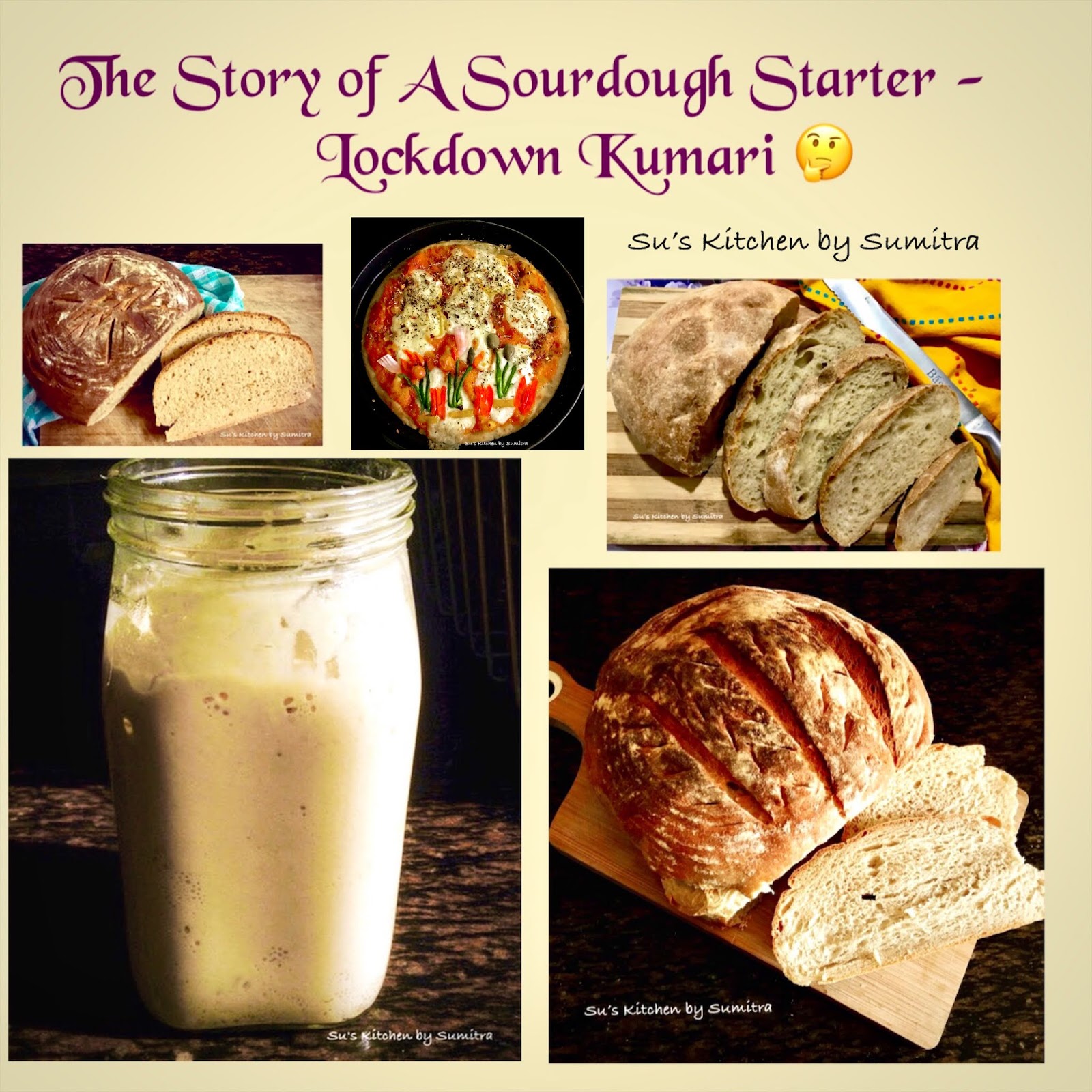
The story of a Sourdough Starter - Lockdown Kumari


Sourdough Starter - Lockdown Kumari 
It’s truly phenomenal... from 2 simple ingredients, how a wild or natural yeast can be cultivated. It can be easily made at home... patience and time are the 2 key factors. 
It’s the best thing to engage your kids too. Do experiment... It’s an amazing experience to take care of the starter like your baby... Do name your sourdough starter baby... 
What should I name? ðŸ¤” Lockdown Kumari....
I had taken a class on how to make sourdough bread in Singapore, I had got the starter from the sourdough bread class, when I travelled backed to India, I had the starter, but due to some problems I was not able to feed the starter and it eventually died.. it’s been 2 years .. Since I didn’t have the starter, I was unable to make the sourdough bread.. but now thanks to the lockdown, I thought of making my own starter. 
Any flour can be used whole wheat or all purpose flour or rye flour or bread flour etc... and liquid like water or fruit juice like pineapple juice or apple juice etc. 
Here we will use All Purpose Flour and Water. One of the feed I used Whole Wheat flour. 
Here I will share my journey of making the sourdough starter from the first day to the last day.. It’s all about my experience.. that I am going to share with we you. 
There are many way the starter can be prepared. All starter will differ from one another and the time that it has taken for the starter to mature.. there can be various reasons like the texture of the flour, the water, the temperature of the place and off course the care that you are taking.. it’s like a baby.... it will take 7 to 10 days.. so don’t give up... feeding the starter is very important... 
We need a clean glass jar like a jam or honey bottle... and the 2 ingredients flour and water. 
Thus the simple way..as we being we will see the changes in the starter... a good starter at the end should float in a glass of water and you will feel the lightness in the starter. 

The Start - 
 Time  - 11.30 pm - Started to cultivate the yeast.
 Preferably start it in the morning or night.. so it’s easy to maintain. Note down the time. Even though I began with 1/4 cup of All Purpose Flour and 1/4 cup of water and a tsp of sugar... we need 1/2 cup of water and 1/4 water.. that’s it.. so the proportion is 2:1.. no need of the sugar.. 
Add the flour and water in the glass jar, stir the ingredients. Incase if whole wheat flour is used, than a little more water might be required as whole flour absorbs more water. The batter should be like a thick cake batter. Place the lid on the glass jar, but don’t lock it. Keep it aside.

Day 1 - 
Time - 11.30 am - Bubbles started to form 
             11.30 pm - Fed the starter 
It many take 12 to 24 hours for the bubbles to show up. I fed the start in the night after 24 hours of the start. First whisk or stir the starter, then we need to discard 50 percent of the starter and then add 1/2 cup flour and 1/4 cup water, stir, put the lid and then keep it until the next feed... 


Day 2 - 
Time - 11.30 am - Fed the starter 
            11.30 pm - Fed the starter 
The starter may need food after 8 hours... I missed the feed, so there was this dark liquid natural alcohol formed called Hooch.. Don’t worry... this indicates that my baby was hungry or incase if the water contained was more in the yeast or if the temperature has increased then there can be a hooch formation.  This doesn’t harm, but discard the Hooch before whisking and feeding the yeast baby.  Incase the hooch formation is more, then increase the feeding frequency or move the starter to a cooler place. 
So the same process of feeding twice a day was followed. Whisked / Stirred the yeast. Discarded 50 percent of the yeast, and added 1/2 cup All purpose flour and 1/4 cup water, stir again. Close the lid and keep it aside .


Day 3 
Time  - 11.30 am - Fed the starter 
             12.30 am - Fed the starter 
Morning After whisking / Stirring and discarding 50 percent of the starter, I had added 1/2 Whole wheat flour and 1/4 cup + 3 tbsp Water and had stirred the ingredients together. Closed the lid and keep it aside. 
It’s ok to change flour. 
Night the same process repeated.. After stirring and discarding the starter, added 1/2 cup All purpose flour able 1/4 cup water. Stirred and closed the lid and kept it the jar aside.


Day 4 - 
Time -  12.30 pm - Fed the starter 
             Night - Didn’t Feed the starter 
Ideally we should be feeding every time the yeast feels hungry, may be in between 12 hours or just in time... but this time I missed the feed in the night. As you observe the starter... in between the feeds,  a good well fed starter will have bubbles and it’s active, when hungry the process of the activity will slow down and look dull. Sometimes the starter is still active and bubbly, then a feed can be skipped.. as over feeding can make the starter sluggish. 


Day 5 -
Time - 9.30 am - Fed the starter 
            10.30 pm - Fed the starter 
In the morning I whisked  and discarded 50 percent of the yeast.  Added 1/2 cup of All Purpose Flour and 1/4 cup water into the glass jar. Whisked well, close the lid and keep it aside until next feed. 
In the night I whisked the starter. Took 3/4 cup of yeast starter and added in a clear fresh jar.  Rest of the yeast I discarded it. Added 1/2 cup of All Purpose Flour and 1/4 cup Lukewarm water into the glass jar. Whisked well, close the lid. mark the yeast level with a marker, so that when the yeast rises you will see that it’s crossed the mark. Keep it aside until next feed.  


Day 6 
Time - 10.30 am - Fed the starter 
            10.30 pm - Fed the starter 
As the yeast begins to ripen we will observe the rise and fall of the yeast as we had marked the level of the yeast. It’s still not matured completely and when hungry the level will fall. 
Whisk and discarded 50 percent of the yeast.  Added 1/2 cup of All Purpose Flour and 1/4 cup lukewarm water into the glass jar. Whisked well, clean the jar with moist paper towel, close the lid and keep it aside until next feed.  


Day 7 
Time - 10.30 am - Fed the starter 
            10.30 pm - Fed the starter 
Now the yeast which has risen is able to hold as it’s a almost a mature yeast. You will see that it’s doubling in size too. 


Evening we did performed a test to check whether the starter is ready to make a bread. If the starter floating in water, it’s time, the yeast has matured. 


In the morning I whisked and discarded 50 percent of the yeast.  Added 1/2 cup of All Purpose Flour and 1/4 cup lukewarm water into the glass jar. Whisked well, clean the jar with moist paper towel, close the lid and keep it aside. 
Evening we did a float test and it was successful. Take a glass full of water, take a spoon of the starter and drop the starter in the water... it should float and able to hold itself in the water. It’s ready to be used for making a bread. Incase the starter is not ready, we have to continue the process until the starter floats... sometime the starter takes time to mature. 


To store the starter in a refrigerator - Whisk and take 1/3 cup of yeast, add the yeast into a fresh jar and discard the rest of the yeast. Added 1 cup of All Purpose Flour and 1/2cup lukewarm water into the glass jar. Whisk well, clean the jar with moist paper towel, close the lid, and keep it in the fridge, feed the starter twice a week.. in the same manner. Incase there is any hooch or water forming, discard the water. When we take a starter to make a bread, take the required quantity mentioned in the sourdough bread recipe and rest at least reserve 1/2 cup starter, feed and store it in the fridge. 

Points to take care - 
Check on the smell... it should give out a tangy smell and not a bad smell, otherwise we will have to start over again. 
Starter is not active - Take a bit extra care, feed well, may be needs extra feeds in between. 
Over feeding - Many a times a feed can be skipped as the starter is very active, over feeding can make the starter sluggish and make the process slow. 
Time - Some time due to the temperature changes, the process of the starter slows down and it takes time to mature. It may take a or 2 extra. 
Liquid on the starter - Due to various reasons, there are liquids called hooch formed on the starter. Just discard it and then feed the starter. Incase you see a frequent hooch formation than probably change the temperature, place the jar into a cooler environment and increase the feed. 
Discoloured starter - Incase you see any growth or colour change, immediately move out the top part and take the lower part of the starter, transfer it into a different glass jar and continue the process... maybe the starter can be saved. 
You are the best judge of your starter... 

Discarded Starter
It’s indeed such a waste, throwing out the discarded starter.m, but we need to do so, otherwise if we don’t discard the starter, the feeding quantity of the starter will increase, the process will slow down and the starter will weaken. As we keep feeding the quantity will keep increasing and so will the quantity of the ingredients.. so it’s best to discard some before adding. But I don’t really throw the discard starter out. Except for the first 2 days, I use the discard starter to make pizza, pancakes, breads etc. 

                                                                          Pizza -


Whole Wheat Bread  - 


Making the Bread - After keeping the starter in the fridge, the day you want to bake a bread, remove the required quantity of the starter, feed  the starter and keep it out for 6 to 8 hours to get a stronger starter. 
Happy  Sourdough Bread Baking 🤗

Monday, 1 June 2020

Pizza base with Discard Sourdough Starter and Whole Wheat Flour Batter


Pizza base made with discarded sourdough starter and whole wheat flour batter... loaded with homemade pizza sauce and mozzarella cheese. I don’t throw discarded sourdough starter...
This time I made easy pizza base without kneading... came out well.
Those who want to start the sourdough starter, here is the link below-
Sourdough Yeast Starter


Ingredients
1 cup of Discarded Sourdough Starter
2 1/2 cup of Whole Wheat Flour
1/2 tsp Instant Yeast
Salt to taste
1 tsp Sugar
Lukewarm Water as required
1 cup of Pizza Sauce
1 medium block of Mozzarella Cheese
Vegetables of your choice like capsicum, onion, tomato, olives and chillies..

Method
Take the discarded starter, add the sugar, instant yeast and 1/2 cup of lukewarm water. Mix and leave it for 15 minutes. Now add the wheat flour, salt and more lukewarm water to make a thick batter. Leave the batter to rise. Take a pizza tray, pour the batter.. depending upon how thick you want the bread to be. Tap it and leave it covered for 15 minutes. Bake in a preheated oven at 180 degrees celsius for 10 to 15 minutes. Remove the pizza tray... prick the base with a fork and then spread the pizza sauce and add the cheese. Bake it for 10 minutes, remove and add the vegetables and bake it again for another 10 minutes.

Vali Bhaji / Mayalu Pannache Koshimbir


Malabar Spinach Salad / Koshimbir 
Supriya, my fb friend had posted her mom’s recipe of Mulangi Pannache koshimbir (Raddish leaves Salad) on her page Mom’s Kitchen to Mine... I instantly felt in love with the recipe... I had lots of Vali bhaji growing in my balcony. Wanted to give it a try with Vali Baji and voila!
It was delicious. Radish leaves would taste a bit different due to the pungent peppery taste of the leaves, but enjoyed this salad too. Simple recipes are always delicious. 
I followed the recipe.. Wash the leaves thoroughly... and then cut it. Sprinkle little salt and leave the leaves for 10 minutes... wash it again and then add the other ingredients. 
I used desiccated coconut but would prefer fresh coconut.

Ingredients 
10 to 12 medium size Malabar Spinach Leaves cut into fine strips 
1 Green Chilli chopped
1 tsp Lime juice 
Salt to taste
1 tsp Sugar
1 to 2 tbsp Fresh Coconut grated or Desiccated Coconut 
2 tbsp Roasted Peanuts crushed

Method 
Take a bowl, add the Malabar spinach leaves, green chilli, salt to taste, sugar and lime juice. Mix well. Now add the coconut and peanuts and toss well. Serve it immediately. 

Friday, 29 May 2020

Masoor Dal aur Sabji ke Pakore


Hungry, missing chai pakore stalls and want some tasty delicious snacks with garma garam chai, then try out this easy and quick to make snacks... this pakora can also be made with dals like moong and chana or can be made with mixed dal. Serve this pakora with chutney and tomato ketchup or imli ki chutney. It’s delicious. 

Ingredients 
  • 1/2 cup Split Red Lentils / Masoor Dal washed and soaked in water for 30 minutes 
  • 1 small Onion chopped
  • 2 Green Chillies chopped
  • 1 tbsp Coriander leaves chopped 
  • 1/4 cup chopped mixed vegetables ( carrot, capsicum, beans, cabbage )
  • Salt to taste
  • 1/2 tsp Turmeric powder 
  • A pinch of Soda Bicarbonate 
  • Oil to fry 


Method 
Take the soaked Masoor Dal and drain out excess water. The Masoor Dal has to be coarsely ground into a paste. The paste should be of thick dropping consistency. Remove the paste in a bowl. Add salt and turmeric powder, stir or whisk the paste well in one direction to incorporate air. Take oil in a wok and let it heat. Add the onion, green chillies, vegetables and coriander leaves. Mix well. Add the soda bicarbonate and mix well.. Reduce the flame to medium. Add one tbsp of the paste into the hot oil, repeat the process for 5 to 6 times or until the wok is filled with the pakoras. Fry the pakoras until crispy and brown in colour. Serve hot with green chutney and tomato ketchup. Enjoy the pakoras with a cup of garam chai. 

Monday, 25 May 2020

Grilled Fish


Grilled fish can be eaten as one of the healthy starter or can be enjoyed for dinner with some salads. Grilled fish can be marinated in many ways. Boneless fish or slices of big fish can be used for grilling. Bhetki, Basa, Ghol etc can be used for grilling. 

Ingredients 
6 pieces of Ghol fish slices 
1/2 cup Hung Curd
3 tbsp Mayonnaise 
1 tsp Garlic paste 
Salt to taste
1 tsp Pepper Powder 
1 tsp Kashmiri Chilli powder
1 tsp Garam Masala powder 
1 tsp Cumin seed powder 
1 tbsp Besan / Chickpea flour 
1/2 tsp Carom seeds
1 tbsp Mustard Oil 

Method 


Marinate the fish with all the above ingredients well and keep it for an hour or two. Take a foil and spread it on a baking tray. Keep the fish slices on the foil. Add some of the marinade on the fish. Grill the fish in a preheated oven at 200 degrees celsius for 10 minutes. Remove the tray from the oven. Turn the fish gently and apply the remaining marinade on the fish, continue to grill for another 10 minutes. Remove the fish and serve the fish with green coriander chutney and spicy mango -  cucumber - tomato salad. 

Sunday, 24 May 2020

Methia Keri


It’s a Gujarati Raw Mango pickle made with fenugreek seeds or fenugreek dal. It doesn’t need cooking, mix the spices and keep it in a corner. In 2 weeks time the pickle will be ready to eat. Enjoy with thepla, dal rice or paratha. 

Ingredients 
 1/2 kg Raw Mango washed, dried and cut into small pieces 
2 tbsp Split Mustard seeds 
1/4 cup split Fenugreek seeds
Salt to taste 
1 tsp Turmeric powder 
1/4 cup Red Chilli powder 
1/4 tsp Asafoetida 
1 cup Sesame Oil


Method 


    Add the mangoes in a mixing bowl. Add the split fenugreek seeds, spilt mustard seeds, turmeric powder, salt, chilli powder and asafoetida. Mix all the ingredients well. Add the pickle in a clean glass jar. Pour the oil. The mango pieces and the spices has to be cover in the oil. Cover and keep the jar in one corner of the house. Stir the pickle with a clean ladle every day. The pickle will be ready in 2 weeks time. 

Aavakai


This a famous raw mango pickle from Andhra. It’s very commonly made in every household in Andhra during summer. It’s spicy and hot. It’s served with curd rice.

Ingredients
1 kg Raw Mangoes, washed, wiped and dried and then cut each mangoes into 6-8 pieces with kernel
10 to 12 Garlic cloves
1 tbsp Garlic coarsely ground
1 cup Mustard seeds sun dried and powdered
2 tbsp Fenugreek seeds sun dried and powdered
1/2 tsp Fenugreek seeds
1 cup Salt
1 cup Chilli powder
1 tsp Turmeric powder
1/4 tsp Asafoetida
1 tbsp Black Chana (optional)
1 1/2 cup Sesame seed oil

Method
Spread the mango pieces on a dry cloth and dry them for 4 hours. In a mixing bowl add salt, mustard powder, chilli powder, turmeric powder, fenugreek powder and asafoetida, mix well. Now add the garlic cloves, garlic paste, fenugreek seeds, black chana and some sesame seeds oil and mix well. Add the mango pieces and mix the spices well with the mango pieces, it should coat the mango well. Add these spice coated mango pieces to the jar. Pour the remaining oil on the top and cover the jar and keep it in a dry area. After 3 days open the pickle and check. Take a dry ladle and mix the pickle. If need be adjust the salt or add more oil if required. The mango pieces should be covered in oil. Stir the pickle once every day with a clean ladle. It takes 15 days for the pickle to get ready.

Saturday, 23 May 2020

Amer Jhal Aachar


This is a spicy raw mango pickle from Bengal. It’s made without cooking, The pickle is with wet paste,  dry spice powder and mustard oil. This pickle can be eaten by rice dal, paratha or luchi.

Wet Paste
Ingredients 
3 tbsp Mustard seeds
10 Green Chillies
2 inches of Ginger cut into pieces 
1/2 cup Vinegar 

Method 
Grind all the above ingredients into a paste.

Dry Spice Powder 
Ingredients 
2 tsp Cumin seeds
2 tsp Coriander seeds 
2 tsp Fennel seeds
1 tsp Nigella seeds
1/4 tsp Fenugreek seeds
5 Dry Red Chillies

Method 
Dry roast all the ingredients, cool it and grind the ingredients into a powder. 

Jhal Achaar 
Ingredients 
1 kg Raw Mango washed, dried and cut into medium size pieces 
1 tsp Turmeric powder 
1 tsp Kashmiri Chilli Powder 
2 tbsp grated Jaggery 
Wet paste
Dry spice powder 
1/2 tsp Dry Roasted Panch Phoran 
3 to 4 Roasted Dry Red Chillies 
Mustard Oil enough to soak the mango pieces

Method 
Take the mango pieces, add the turmeric and salt. Spread the mango pieces on a cloth and sun dry it for 3 to 4 hours. Heat the mustard oil and cool  the mustard oil down. Take the mango pieces in a bowl, add the salt, chilli powder, dry spice powder, jaggery and wet paste. Mix all the ingredients together very well. Add the mustard oil and transfer the pickle in a clean glass jar. Add the dry roasted panch phoran and roasted dry chillies. Keep it in the sun for few day. Keep a check, if required add more salt. Once ready the mangoes will become soft in oil. 


Chunda


It’s a popular Gujarati spicy sour and sweet pickle. It doesn’t require any cooking. It’s a very easy delicious pickle that goes will with Paratha and thepla. 

Spice Powder 
Ingredients 
1 tsp Cumin seeds 
4 Red Dry Chillies
2 Cardamom pods

Method 
Take a pan and roast the cumin seeds, let it cool down, coarsely grind the cumin seeds with red chilli and cardamom. 

Chunda 
Ingredients 
1 1/2 cup Mango washed, peel and grated 
1 1/2 cup Sugar
Spice powder
Salt to taste
1/2 tsp Turmeric powder 
Few strands of Saffron (Optional)

Method 
Take the grated mango and add salt and turmeric powder. Keep it aside for 30 minutes. Squeeze the excess water out. Take a clean glass bottle, add the mango, sugar and spice powder and saffron (optional). Mix it. Leave it in the sun for few days. Keep a check. The sugar will dissolve and will cook up with the mango to a one string consistency. Enjoy the chunda with the paratha and thepla . 


Aam Ka Kucha


This is a Raw Mango pickle recipe from Bihar. As the mangoes are grated it’s called kucha. The spices and oil are added to the grated mango and  it’s kept in the sun to mature. 

For the Dry Spice Powder 
Ingredients 
    1 tsp Cumin seeds
    1 tsp Coriander seed
    1/2 tsp Carom seeds
    1/2 tsp Fennel seeds
    1 tbsp Yellow Mustard seeds
    1/4 tsp Nigella seeds
    Few Fenugreek seeds
    6 Red Dried Chilli 

    Method 
    Roast all the above ingredients, cool it and dry grind it. 

    For the Aam Ka Kucha 
    Ingredients
    1 1/2 cup Grated Mango 
     Salt to taste
    1 tsp Turmeric powder
    1 tsp Chilli powder 
    Dried spice powder 
    1/2 tsp Nigella seeds
    1 cup Mustard Oil

    Method 
    Take the grated mango, apply salt and 1/2 tsp turmeric powder. Keep the mango on a strainer for 15 to 30 minutes. Squeeze the water out from the mango. Take a bowl, add salt, turmeric, chilli, spice powder and  nigella seeds in the bowl. Mix all the ingredients together. Add the oil and mix it. Take a dry clean glass bottle. Pour the pickle in the bottle. Keep it in the sun for few days. Keep a check. Once the mangoes becomes soft and matured the pickle is ready to be eaten. 


    Aam Tel


    This is a mango and spiced flavoured oil, that is used in Bengali Cuisine. This oil is used for mashes vegetables that we call bhate or used to flavour puffed rice that is eaten for snack.

    Spice Powder
    Ingredients 
    1 tsp Panch Phoran
    1 tsp Mustard seeds
    1 tsp Coriander seeds
    2 Red Dry Chillies 

    Method
    Roast all the ingredients together and let it cool, dry grind the ingredients into powder.

     Aam Tel
    Ingredients 
    1 medium size Raw Mango washed, dried and cut into medium size cubes.
    1/2 tsp Panch Phoran Roasted
    4 Whole Red Dry Chillies Roasted
    Dry spice powder
    Salt to taste
    1/2 tsp Turmeric powder
    1 cup Mustard oil, heated and cooled down

    Method
    Take the mango pieces, add turmeric and 1 tsp salt, rub the mangoes well, spread the mango pieces on a clean cloth and dry it for 2 to 4 hours under the sun. Take all the ingredients and the mango pieces in a bottle. Keep it in the sun for few day. It’s ready to be used.

    Aam Kasundi


    Kasundi is a very popular mustard pickle used in Bengal and it is made by fermenting mustard seeds and spices in a mud pot. In modern times it’s highly used as an accompaniment with the chops, cutlets and various fried snacks. It’s also used in cooking. Traditionally it’s was made with lots of rituals and many restrictions were followed while making the Kasundi. Now it is made at home with ease. There are many spices added to the Kasundi. Apart from traditional Kasundi there are now many ways and ingredients used in making the Kasundi. 
    Here I have made Aam Kasundi. 

    Ingredients 
    1 big size Raw Mango washed, peeled and cut into small pieces 
    4 Green Chillies 
    2 small pieces of Ginger
    1/4 cup Yellow Mustard seeds 
    1/4 cup Black Mustard seeds
    Salt to taste 
    1/2 tsp Turmeric powder 
    1 tsp Sugar 
    1/4 cup Vinegar 
    Normal temperature boiled water depending on the requirement

    Method 
    Take a grinder jar, add yellow mustard seeds, black mustard seeds, green chillies, raw mango pieces, ginger, salt, turmeric powder and sugar. Add vinegar and water little at a time blend it into a fine paste. The paste has to be of dropping consistency. Take a glass jar, pour the Kasundi paste. Close the lid and keep it in the sun for few days. Check the Kasundi every day, incase if you find the salt is less than you can add salt. Stir it with a clean dry spoon. 

    Monday, 18 May 2020

    Malai Tangdi Kabab


    Now the best way to enjoy restaurant food is to make it at home, one of my favourite restaurant dish is Malai kabab... I had 6 pieces of chicken tangdi at home. So marinated the chicken tangdi. Since the kababs are made in tandoor and we don’t have at home, we can give a smokey flavour by burning a charcoal piece and placing it on a small plate and placing the plate on the chicken pieces and pouring little oil over the charcoal and closing the bowl with a lid, before grilling the chicken pieces. 
    This dish can be had as a starter. Garnish the Kabab with onion, mint, tomato and green chutney. 
    Ingredients 
    6 Chicken drumsticks 
    1 tsp Garlic paste
    1/2 tsp Ginger paste
    Juice of 1/2 Lime 
    1/4 tsp Fresh Green Chilli paste 
    1/4 tsp White Pepper Powder 
    3 tbsp Fresh Cream 
    4 tbsp Hung Curd 
    1/2 tsp Shahi Garam Masala powder 
    Salt to taste
    1 tbsp Mustard Oil 
    1 tsp Butter 
    Onion rings, Mint leaves and tomato for garnishing 

    Method
    Take a bowl, add the curd, ginger, garlic, green chilli, lime juice, salt,  pepper and garam masala and mix well, add the chicken tangdi. Rub all the ingredients well. Marinate it for minimum 2 hours. The longer it’s kept it’s better. I had kept it for 8 hours. Now add the cream and the mustard oil and keep it for another 2 hours. 
    Preheat oven at 200 degrees celsius. Place a aluminium foil on the baking tray. Place the marinated chicken drumsticks on the foil. Add some marinated juices, put the tray in the preheated oven and grill it for 15 minutes, remove the tray and turn the chicken pieces, add the remaining marination and grill for another 15 minutes. Remove the tray from the oven, apply butter on the chicken tangdi. 
    Serve hot garnished with onion rings, mint, tomato and green chutney. 


    Thursday, 14 May 2020

    Raw Mango Jam


    I had got a good quantity of Raw mangoes to make various types of pickles... after cutting the mangoes into desired pieces, the seeds of the mangoes and some scraping from the mangoes remained... I was in two minds, either to make raw mango squash or Jam... finally decided on making the Jam... 
    Home made Jams are best as no preservatives are used... 2 main ingredients are used Raw mango pulp and sugar... 
    There are optional ingredients that can be added to enhance the taste like Cardamom pods, Red Chilli flakes, garlic, Bacon mince etc. 
    If you love pork, you must add fried bacon mince or fried bacon pieces into the Raw mango jam and have it with toasted bread... it’s yum... 


    Here I had used 15 mango seeds and 1 cup scraping from the raw mango, to which I had added 2 cups of water, 1 tsp of Rock salt, 1 tsp of turmeric powder for the colour and 2 crushed Cardamom, pressure cooked it and strained the pulp through a wire-mesh strainer.

    Ingredients 
    2 cups of Raw Mango pulp 
    2 cups of Sugar or more as per the sourness 

    Method 
    Take the raw mango pulp and the sugar in a heavy bottom pot, on a low flame, let the pulp and sugar simmer, and occasionally keep stirring the ingredients. Occasionally keep cleaning the sides of the pot and remove the scum that forms on the top. Once the pulp reduce, thickens up and changes it’s colour, check if the jam is ready, take a small steel plate, keep it in the fridge and cool it. Take the plate and pour 1/4 tsp of the jam, if the jam starts to set then it is done. Cool it a bit. Take a clean glass bottle and pour the jam in the bottle and let it set in the bottle. Enjoy it with bread, roti or paratha.


    Monday, 11 May 2020

    Pangasius (Indian Basa) Maccher Aloo Pholkopir Jhol


    Pangasius (Indian Basa) Maccher Aloo Pholkopir Jhol - Aaaahaaaaa ... it’s heaven having it with one plate of steamed Rice... it’s been some time that, I was craving for fish very badly ... yesterday my husband managed to order online from Fresh to Home and finally today morning it was delivered. Couldn’t wait... immediately cooked this fish the traditional Bengali way... The regional dishes are simple but always divine.
    This curry can be made with any other fish like Rahu, Katla, Bhetki etc.. it can be made only with potatoes. Cauliflower can be replaced with pointed gourd...


    Ingredients
    500 grams Pangasius cut pieces, washed and apply turmeric and salt...
    2 Medium size Potatoes peeled and cut into medium size chunks
    1 Medium size Cauliflower cut into medium size florets
    1 Medium size Onion cut into big pieces
    1 Medium Tomato cut into big pieces
    4 Garli Cloves
    2 Inch Ginger cut into pieces
    4 Green Chillies slit
    Salt to taste
    1/2 tsp Sugar
    1/2 tsp Turmeric powder
    1 tsp Cumin powder
    1 tsp Coriander powder
    1 tsp Garam Masala powder
    1/2 tsp Cumin seeds
    2 Bay leaves
    1/2 tsp Ghee (optional)
    1/2 cup Mustard Oil for frying the fish and making the curry

    Method
    Dip the cauliflower and potato in hot salt water for 5 minutes and drain out the water. Make a paste with the tomato, onion, garlic, ginger and 2 green chillies. Take a wok, add oil, let the oil heat up, reduce the heat to medium flame. Add the marinated fish and fry until light golden brown in colour. Remove the fish from the oil. In the same oil add the potatoes and cauliflower, add little salt and turmeric powder. Stir fry the potatoes and the cauliflower until it changes it’s colour. Add the cumin seeds, bay leaves and the 2 remaining green chillies,  stir and cook for a minute. Add the paste, sugar and little more salt to taste. Continue to cook for 2 minutes more. Add the cumin powder, coriander powder and the garam masala. Here if you want you can also add red chilli powder, but I haven’t used it. Stir and cook for 2 to 3 minutes more. Now add around 2 1/2 cups of water.. let the curry simmer until the vegetables are cooked. Add the fried fish.... let it simmer for another 5 minutes more. Switch off the flame, drizzle ghee on top and serve it hot with steamed rice.


    Saturday, 2 May 2020

    Whole Red Lentils and Prawn kebab


    This recipe is good for snacks or can be served as starter. This can be served with Onions, lime and Mint - Coriander Chutney It’s easy to make with ingredients mostly available at home. This can be a good lockdown recipe for all the fish lovers.. 
    Ingredients 
    1/2 cup Whole Masoor dal / Whole Red Lentils soaked for 4 to 5 hours 
    18 to 20 pieces  of clean medium size Prawns 
    2 small piece of Ginger
    1 Whole Green Chilli
    2 Garlic Cloves 
    1 medium size Onion chopped 
    1 Green chilli chopped 
    1 tbsp chopped Coriander leaves 
    1 tbsp chopped Mint leaves 
    1 tsp Cumin powder 
    1/2 tsp Coriander powder 
    1 tsp Chilli powder
    1/2 tsp Garam Masala powder 
    1/2 tsp Amchur powder
    Salt to taste
    1 Egg
    Oil to shallow fry 


    Method 
    Wash the masoor dal and remove all the extra water from the dal. Take a grinder jar, add the Masoor dal, prawns, ginger, garlic, whole green chilli, salt, cumin powder, coriander powder, chilli powder, Garam Masala powder, amchur powder and egg into the jar. Don’t add extra water, grind the ingredients into a fine paste. The paste should not be of the dropping consistency or very watery. Remove the paste in a bowl, now add chopped onion, chopped mint leaves and coriander leaves. Mix the ingredients. Take a pan, add oil. Let the oil heat up. Take small portions from the paste with the help of a tbsp spoon and put it into the oil. Flatten the paste with the help of the spoon, fry until golden brown. Serve it with onion, lime and mint Chutney. 


    Wednesday, 29 April 2020

    Instant Suji Jalebi


    If you have a sweet tooth like me and craving for sweets in this lockdown period, then try this instant Suji /  Semolina Jalebi and enjoy this with your family. This recipe is inspired from Nisha Madhulika ji’s Suji Jalebi recipe, with changes made in the measurement of all purpose flour and sugar, I have used turmeric as a food colour and add a bit of salt for the balance. 

    For the Sugar Syrup 
    Ingredients 
    1 cup Sugar 
    Juice of 1/2 Lime 
    1 cup Water 
    Method 
    Take a pot, add the sugar and water, let it simmer until one string sugar syrup has formed. Switch off the flame and add lime juice. Keep it aside. 


    For the Jalebi
    Ingredients 
    1 cup Fine Semolina 
    1/2 cup All Purpose flour 
    1/2 cup Curd 
    1/2 tsp Turmeric for the colour or use 1/4 tsp yellow food colour 
    1/2 tsp Baking powder 
    1/4 tsp Salt
    Ghee for frying 
    Method 
    Take a bowl, add all purpose flour, semolina, salt, baking powder, turmeric or food colour and curd, now add little water at a time and whisk the batter, until you get a thick dropping consistency. Keep the batter aside for 30 to 40 minutes. Take a pan, add ghee, let the ghee heat up. Take a piping bag, pour the batter into the piping bag, cut a small end of the piping bag. Once the ghee is heated up, reduce the flame to medium. Hold the piping bag straight at a distance from the ghee, rotate your hand to form a 2 1/2 swirls. Fill up the pans with jalebis. Fry the jalebis until crisp, and the colour changes to golden yellow. Remove the jalebis and drain out the ghee. Place the jalebis in the sugar syrup. Keep the jalebis in the syrup until the sugar syrup is absorbed. Remove the jalebis and serve.